
1. Withdraw from ideas dear to medicine and science; there are two ways to think about teeth. The first, which necessitates an act of abstraction or requires a special context, is to think of teeth as singular entities, separated from the mouth’s encompassing totality; i.e. alone, as tooth. This initial image belongs to the dental clinic, invoking the extracted molar in a steel tray or the enamel tooth-like logo on its door. It also belongs to the tooth fairy – an encompassing figure whose mythology remains uncertain and varies across cultures, yet persists nonetheless in the collective imaginary – drawing attention to the fallen milk tooth placed somewhere special, perhaps as a token of exchange or a memory: under a pillow, thrown over the roof, buried in the garden, kept in a small box, in a parent’s drawer years later, forgotten. This first thought of teeth presents them without habitat, outside their own territory, like fragments of the body, detached, investigated, and ritualized. These, then, are the deterritorialized teeth: separated from function, from power, from home, like relics of a past, like souvenirs of a once integral body.
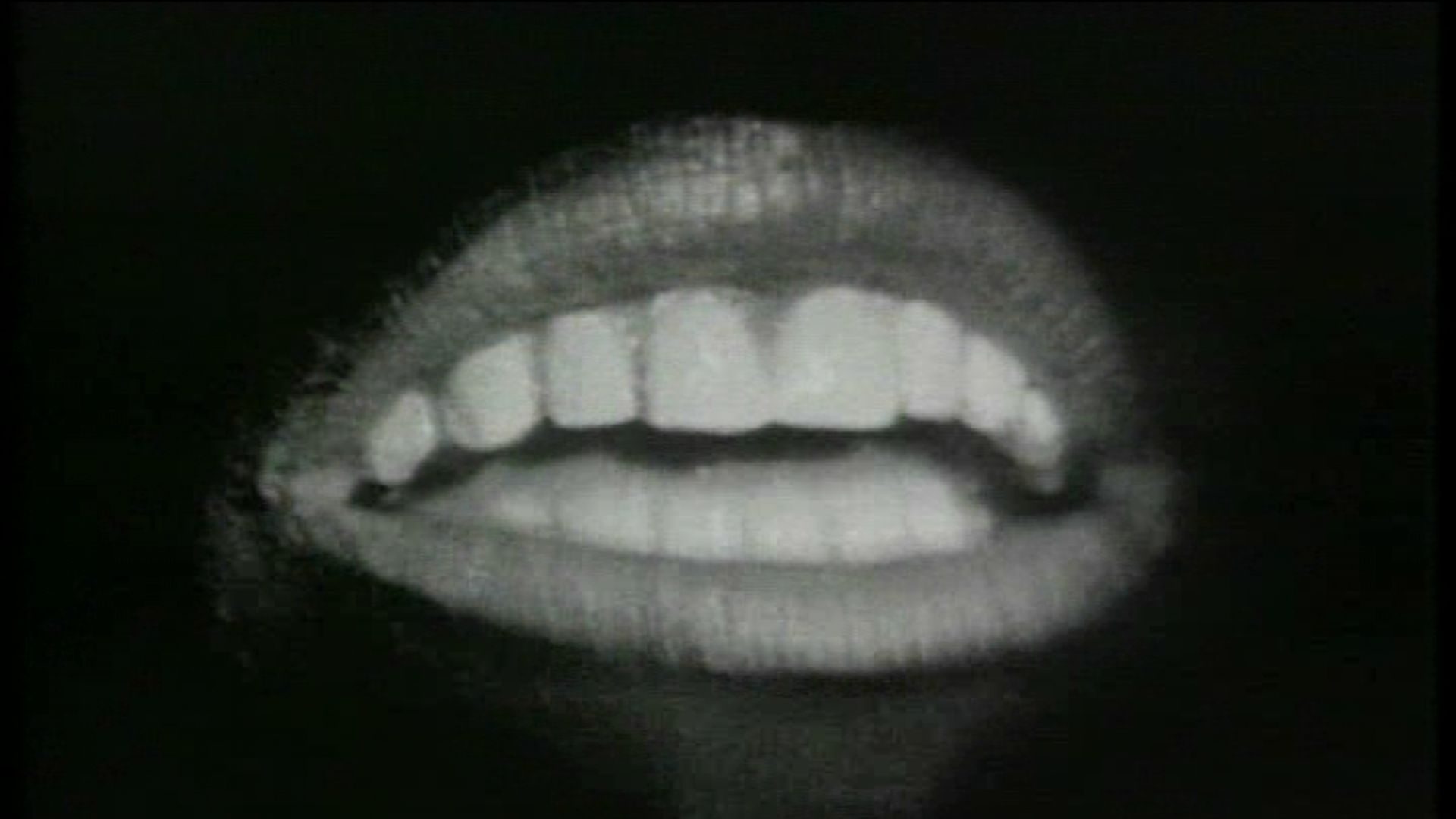
Frame from Samuel Beckett, Not I, 1972 (1977). Audiovisual recording, Single-channel video, b/w, sound, 11 min 52s. MACBA Museum of Contemporary Art of Barcelona.
The second, which seems more usual thanks to the naturalness of its emplacement and frequency of encounter, is to think of teeth as part of the mouth – as constituent elements composing what becomes, in certain moments of bliss and happiness, fragments of a smile. A smile is a function (or power), and the territory of the mouth operates through a rich economy of functions: mastication, speech, breath, taste, desire. By contributing to such a function, alongside the others, at different moments in such a place, these are the territorialized teeth – integrated into the systems of the mouth, distributed across multiple economies: aesthetic, digestive, linguistic, erotic.
2. In the case of teeth (perhaps more so than other things), language forces the direction of thought and imagination. The usage of the singular, “tooth”, compels an act of abstraction: the imagination brings forward a singular tooth suspended in mental space, white against darkness, isolated from the members of its species. The usage of the plural, “teeth”, by contrast, summons the mouth entire – sometimes including elements not mentioned but implicitly necessary for the completion of the territory: the gums, the lips, the tongue, the wet atmosphere of the mouth –, or otherwise the whole set of teeth, usually thirty-two in number for an adult human (though the imagination does not count nor deal in numbers), arranged approximately correctly.
Yet when one uses the singular form with context – as in “my tooth aches” –, abstraction collapses. The imagination refuses the floating tooth because the imagination knows all too well that a separated, deterritorialized tooth, a tooth expelled from the gum, cannot hurt: at least not the “my”, as it would no longer be part of the speaker. Pain requires territorial integrity: the ache belongs not to the tooth itself, but to the mouth as a system within systems. In such a case, despite the singular, the whole mouth is imagined; whichever specific tooth aches becomes irrelevant.1 What matters is its affect: that it hurts.
Additionally, and especially when imagination is involved, teeth might form systems beyond the mouth’s limited territorial boundaries. That is to say, once deterritorialized, teeth can be reterritorialized within entirely different economies, exercising other functions, proving different powers: teeth as tokens (the tooth fairy’s commerce), teeth as currency (walrus teeth once used by the Inuit, dolphin or whale teeth used in Pacific Islands), teeth as holy relics (Christian saints’ molars carried in reliquaries), teeth as evidence of presence and passage (archaeological specimens, forensic identifiers), etc. The deterritorialized tooth thus enters new circulations.
Inversely, the deterritorialization of the tooth leaves a vacancy – an empty socket, a gap in the gum – that demands occupation, an ersatz for the natural power lost. This is the dentist’s intervention: substitution rather than restoration. The implant, the crown, the bridge – these are all prosthetic colonizers claiming space where a natural tooth (or segment of tooth) once stood. In the most extreme cases, when old age or brutal violence has emptied the mouth entirely, the whole territory must be reconstructed: the complete denture becoming a portable smile, a detachable artifact, worn and removed at will.
Then we must understand: teeth are singular entities that make up systems – many systems, overlapping and distinct. They inhabit territories and, by inhabiting them, create and shape them. A tooth is rarely just itself; it is always part of something larger, always participating in some economy of function. Therefore, to understand teeth requires mapping their territories. Consider:
A. As long as language is not limited to script, the mouth contains a multitude of sonorous regions – chambers, passages, surfaces. Teeth partition this acoustic space and regulate the sonorous regions of the mouth: teeth create trails. The sounds of childhood, tuned to the mother tongue (the lullaby, the first word), train the partnership between tongue and teeth – especially the incisors, which aid most in the clear pronunciation of words by controlling airflow and facilitate articulation by providing surfaces for the tongue to press against, crevices through which air hisses, gates that open and close passage. Without teeth, sound collapses, becoming shapeless.
One might speculate: in the shape of teeth reside, are imbued, the rhythms of the mother tongue. One provocative question follows: does the learning of the mother tongue during development (i.e., the growing-up process) – which consists of both the first appearance of the deciduous teeth and their subsequent and gradual replacement by permanent teeth – determine the shape of the teeth, their relief, ridges, and islands? That is, recognizing the rhythms and vibrations that the deciduous teeth experience during childhood, are the permanent teeth (waiting in expectation inside the skull) virtually reconfigured, prepared for the common language at the time of their actualization?
The answer: no. Scientifically disproven. Tooth morphology is genetic, environmental, nutritional, but not linguistic. The mouth does not reshape its bones to accommodate its language. And yet, the question remains pertinently imaginative. Because, even if the teeth do not change for the tongue, the tongue certainly changes for the teeth. Speakers of languages with dental consonants (θ, ð) position the tongue differently than speakers of languages where they are missing, or less common.2 Adaptation runs in one direction: the mouth learns its language, adapts to it, even if language does not remake the mouth. And yet, the mouth becomes its language. French mouths are not English mouths are not Arabic mouths are not nonhuman mouths – not in the way they rest, not in the way they move.3 Language operates as territory on multiple strata: corporeal (the mouth, the teeth, the tongue) and extra-corporeal (political borders, ethnic identities, geographical distributions).
Then, what can be stated with more certainty is that the acquisition of the mother tongue is processed on the deciduous teeth. The tongue trains on them. Subjects them to experimentation. So, when the old teeth are replaced by new ones, the tongue engages them in a more assured and direct way. The tongue knows where and when to go, what to hit, and how hard: sibilants find their grooves, fricatives their friction, plosives their targets.
B. Territories have spatial characteristics. An inside and an outside: teeth belong to both worlds – more or less virtually, more or less actually –, revealed and concealed by the opening and closing of the lips. Upper and lower: teeth occupy both arches, maxillary and mandibular, standing tall and hanging low. Left and right: teeth sit on both sides of the face, rooted in alveolar sockets, symmetrically placed but asymmetrically becoming. Teeth begin in a state of bilateral symmetry (product of genetic blueprint, as shown by dental charts) but become continuously through use, through preference, and through the accumulation of unequal forces. The whole face is modified by chewing habits, by preference exercised over decades, acquired during youth. Studies show that around 70% of people chew predominantly on one side:4 such a recurring event is called “unilateral mastication”. Naturally, the more frequent engagement of the preferred side leads to differential wear. The right side grinds, while the left side waits. Most of the time. Over decades, the right molars flatten while the left remain sharp: a flatland separated by the sea of tongue from mountains. Temporal evolution tilts the face imperceptibly: the jaw shifts, the muscles become prominent here but not there, making one side fuller and wider, the other flatter and less defined – cheek height differs, lower face width, chin alignment unparallel to the ground or sky or smile line, changes in bite alignment. Good photographers know this: everyone has a good side. And the good side is often the less-used side – the side not yet (not ever?) worn down by preference, by habit, by the slow erosion of function.
The “preferred” teeth are worn, gravely affected, decayed. To be chosen is to be affected, worked, terminated. By way of these preferences, the face transforms into a record, an archive of asymmetric activity. What’s at stake in this process isn’t symmetry disrupted, but symmetry becoming – becoming unequal, becoming particular, becoming itself through the experience of usage.
The magnitude of these variations proves that the chewing function does not take place at the level of a single tooth, nor at the level of a symmetrically placed pair. Teeth aren’t hydraulic presses. Chewing is a collective effort: an entire half of a mouth mobilized at once (more or less sixteen teeth, depending on the individual’s dentition, depending on the size of the food). An entire half, yes, but not an entire mouth. The chewing function works with difficulty – becomes inefficient, uncoordinated – when both sides engage simultaneously. The bilateral coordination required to engage both sides at once disrupts the grinding rhythm, diffuses pressure, reduces efficiency. It doesn’t make use of “the occlusal surfaces” that turn into “a series of sharp-edged enamel ridges separated by infundibula and low-lying islands of dentin.”5 It doesn’t use the natural cuts of the teeth. Hence the preference for unilateral mastication: the mouth works best as divided labor, as half engaged while half waits. As counterbalance.
C. The teeth compose the mouth; they carry the smile, structure the face. A face without teeth becomes other, a mask – loses its shape, its fullness, collapses into empty space. The lips sink inward, the cheeks hollow, the chin advances. Following these considerations, it becomes naturally fair to believe that the teeth support or constitute the aesthetic system of the face.
In certain cultures, teeth are filed, blackened or adorned with gold – not for motor function, but for signification. They represent power, status, maturity or wealth. Teeth become social currency, positioning the bearer within the social hierarchy. The Māori filed their teeth as marks of rank. The Balinese blackened theirs to distinguish human from animal. In Victorian Europe, gilded teeth could become a display of affluence.6 Teeth signal who you are before you speak (as long as you do).7
So: teeth function according to the same dichotomy as ritual objects. When extracted from their natural habitat – the living mouth, the practicing culture – they become something else entirely. Just as religious relics or symbols of power pertaining to non-Western, “uncivilized” cultures were converted, in European museums, through an iconoclastic gesture, into mere objects of aesthetic appreciation, stripped of sacred function, so too do extracted teeth lose their social meaning. They’re reterritorialized into a different logic.8 (An old tooth found by an archaeologist would be differently interpreted than one found by a criminalist.) The filed tooth in a museum vitrine is no longer a mark of rank but a curiosity. The gold-adorned tooth in a collector’s drawer is no longer power but ornament. Deterritorialized, the tooth becomes artifact – interesting, perhaps beautiful, but emptied of the social relations that gave it meaning.
Yet, unlike most ritual objects, teeth maintain a dual existence: they can be both functional and symbolic, both biological and social, simultaneously. A tooth in a mouth is the same one as the ritual or status object still in use, still performing its metaphysical function. Only extraction – literal or metaphoric, willed or accidental – strips it from being this site of double significance.
Therefore, teeth are not merely ornamental or passive conduits of social power. They also exert it actively, through engagement, through the exercise of function. They structure, for example, the possibility of social relation and standing through commensality – the act of sharing food to create bonds. This is a ritualist endeavor achieved through the mastication function. A fundamentally religious one. Anthropologists understand commensality as foundational: to eat together is to establish trust, kinship, alliance. And commensality depends absolutely and ultimately on teeth. Without functional dentition, the social contract of the shared meal collapses.
We can reflect on this. When strangers share a meal, the act communicates equality. The food must be of a texture all can manage, a toughness all teeth can handle. Soft bread for the elderly, tender meat for the child. The meal adjusts to accommodate the weakest dentition in the group – and this adjustment communicates in itself a form of care, of inclusion. The condition of teeth determines what can be shared, and thus what bonds can form.
Or reflect on the inverse: the exclusion or separation of the edentulous from communal eating. Is there shame in the toothless mouth? In the one who cannot chew what others chew, who must eat separately, differently – who must hunt or gather separately, or have specific things hunted or gathered for them? Probably. But this doesn’t go far enough. Consider interpassivity – the act of chewing could be delegated to someone else. The mother, the caregiver, pre-masticating food for the infant: putting teeth in the service of another. A form of co-dependency that is also a form of care. Then we understand, teeth structure social inclusion and standing. Their absence proves dependency, signals exclusion. Teeth are not only biological instruments but social ones – instruments of belonging.
And yet the primordial function of teeth – mastication – can be accomplished by teeth-like replacements, both within the mouth and outside it. The same way a tooth becomes a tool, a tool can become a tooth: a rock or a pestle smashes the hard shell of a nut; a knife slices an apple into pieces, sparing the incisors from biting into it; a mortar reduces grain to flour, anticipating the work of molars; fire softens what teeth cannot break. The outsourcing of mastication is as old as tool use itself, perhaps coextensive with it.
D. As the first component of the gastrointestinal tract, teeth perform the initial step of digestion through mechanical breakdown – functioning as grinders, as millstones, transforming the mouth into the first stomach.9 The primary function of incisors is to cut or shear food into manageable pieces, acting like scissors that allow the first bite of an apple or a sandwich. Yet, as discussed, this digestive function cannot be separated from the linguistic: eating and speaking, nourishment and language, both mediated by the same hard, calcified structures.
But teeth do not limit themselves to this dual mandate of mastication and articulation; they overflow their biological purpose, operating simultaneously as weapons (bared in threat), as signals (hidden in submission), as erotic objects (the lover’s bite that marks possession or desire), as musical instruments (the jaw harp that requires them for resonance), as tools of labor (the seamstress who bites thread, the fisherman who cuts rope between canines), as improvised implements – vice, third hand, clamp – mobilized whenever the hands alone prove insufficient.10
3. Turn and consider accidents at the level of teeth – whether caused during growth (thumb-sucking, tongue-thrusting, prolonged pacifier use11), caused from the vast exterior (following blows and falls, trauma), or caused by the decay of the dentition (cavities, chips, breaks) –, all these modify the resonance of the mouth, since the structure formed through the pair of occupied-empty space is changing, becoming, creating sonic regions just as much as the region of linguistic apprehension promotes certain sounds through accent. Here we meet the gap-toothed whistle, the lisp of the overbite, the muffled consonants of the edentulous. Each representing not mere impairment but acoustic reconfiguration, a restructuring of the mouth’s resonant properties. Each mouth, determined in part by genetic structure, in part by accumulated accidents, shifts its acoustic signature with every alteration. As architectural structure, the mouth operates as follows: lose a tooth, and you lose a wall; the room changes, the echo changes, you hear yourself as a stranger might hear you, others hear in your voice what was not there before, the entire sonic topology reorganizes itself around the void. The fate of every tooth marks its own relief, its own history that registers periods of erosion (stomach acid flux in cases of bulimia nervosa or chronic reflux, or chronic alcoholism), of accidents, of modifications, of genetic determination.
4. If the mouth represents, in its tabula rasa – untouched, ideal – state a unified world, then any departure or deviation from this state opens a world that is no longer itself, a world that has lost its old unity and configuration. Yet, mythologizing through the condition of the edentulous, this might be precisely the fantasy of the original mouth, showing inside the dreams of complete dentition:12 that there exists some prior state of wholeness to which accidents and erosions are merely subtractive. Most mouths, however, are compromised from the start. Most mouths are edited by time, habit, and circumstance. Most mouths bear their history not in presence but in absence, in the gaps and worn surfaces that testify to what has been lost, what has broken, what has been extracted or dissolved.
If teeth possess an internal logic – a defined and re-definable way of being – this logic can only be recovered through external influence and intervention, which is to say that the dentist who claims to recover a lost state is actually (re)colonizing the mouth, imposing a logic from outside so that function may be restored to what it supposedly was, recovering what is imagined to be the territory’s original, natural state. But what, precisely, is being recovered: the tooth as it was, or the tooth as it should have been according to some idealized blueprint, some orthodontic fantasy of proper form? The dentist does not restore so much as invent, since the filling is not the tooth (it is composite resin, amalgam, foreign matter), the crown is not the tooth (it is porcelain shaped like a tooth, a prosthetic shell), the implant is certainly not the tooth (it is titanium screw and ceramic cap, a technological substitution). Yet, in their own ways, each claims the tooth’s territory, occupies the socket as if by right, participates in the system as if it belonged there from the beginning, replacing instead of returning.
5. Archaeologists know too well what morticians and forensic scientists also know: that teeth are the most durable, heat-resistant, and chemically stable tissues in the human body, often surviving intense trauma, decomposition, and cremation that destroys everything else. Every person’s dentition is unique due to distinct patterns of fillings, decay, missing teeth, and morphology, providing a highly reliable and relatively quick “dental footprint” that can be compared to antemortem records. That is to say, teeth outlast their territory, outlast the mouth that once housed them, outlast even the skull that structured them. They become nomadic archives, testimonies without speakers. Long after the soft tissues have decomposed, the teeth persist: in the mass grave where bodies have become indistinguishable, in the ash of the crematorium where bone has crumbled to powder, speaking when the mouth can no longer speak and identifying when the face can no longer be recognized. The archival function of teeth proves that the mouth is not merely an orifice but a world, a portal, a site of multiple inscriptions that future archaeologists will read like text. They will reconstruct our lives from our teeth with startling specificity: what we ate and where we lived – “the interaction of diet, nutrition, and disease […] place of residence and migration”13 – our age at death, our childhood joy or stress and negligence, our vanities (cosmetic dentistry, whitening treatments, veneers that mask what lies beneath). Teeth accumulate, archive, testify.
To insist, then, that teeth are not merely biological instruments – not merely bones, not merely calcium phosphate crystallized into enamel and dentin, not merely tools for mastication but rather sites where multiple systems converge and compete: teeth as territory and territorialization, teeth as linguistic apparatus, teeth as sonic architecture that shapes language even as language moves through them, teeth as the precise location where the body meets language, teeth as historical documents that outlast their authors, where nourishment meets signification, where the living meets death and continues speaking afterward.
- We might speculate that the imagined aching tooth is always among those that ache most often. It rarely happens for the incisors or canines to hurt, so the imagined tooth is positioned further back, among the molars and premolars. This imagined positioning might also be determined by the imaginator’s own experiences: the preferred chewing side, their own past aching experiences, etc. ↩︎
- In phonetics, a dental gesture presupposes that the tongue works as articulator while the teeth work as target (the tip of the tongue hits the upper teeth); while an interdental gesture presupposes that the tongue protrudes between the front (upper and lower) teeth. See Peter Ladefoged & Keith Johnson, A Course in Phonetics, Stamford, Cengage Learning, 2015, pp. 12-13. ↩︎
- This explains the difficulty of code-switching: changing to a different language on the go (as a speaker) demands not only cognitive but motor recalibration. Different jaw positions, tongue pressures, articulatory rhythms. The native accent that persists when speaking a second language registers less as linguistic incompetence than as muscular memory, as habit. ↩︎
- “A majority of the present subjects (68%) had a preferred chewing side.” See L. V. Christensen & J. T. Radue, “Lateral preference in mastication: a feasibility study”, Journal of Oral Rehabilitation, vol 12, nr. 5, 1985, pp. 421-427. ↩︎
- Peter S. Ungar, Mammal Teeth. Origin, Evolution, and Diversity, Baltimore, The Johns Hopkins University Press, 2010, p. 15. ↩︎
- Indirectly so. Teeth gilding was, first and foremost, practical. But, considering the cost, gold could indirectly signal affluence and status. ↩︎
- That is, as long as the mouth opens – possibly for a smile. Because the teeth are otherwise inaccessible to the sight of others. ↩︎
- The display of an object in a new environment changes its history, restructuring it – the object passes a resemantization. An object placed in a museum changes its meaning according to the reality presented by the collection. Colonial curators tasked with administering and managing museum collections “created” art through iconoclastic acts directed against objects of cult or symbols of power, reducing them to simple, dysfunctional objects. In other words, the religious, cultural, or political functions were withdrawn from the essence of the objects and replaced by aesthetic predicates; the objects were placed in settings from which they could no longer manifest their metaphysical potential. African idols or Egyptian cult objects were installed in rooms where they became mere exotic curiosities for Western audiences – addressed to the retina, stripped of the symbolism and powers attributed to them in the territories and among the peoples from which they had been torn. ↩︎
- “These teeth (the molars), along with the premolars, are often used to fragment foods into ever-smaller chunks by shearing, slicing, crushing, and grinding”; reducing the bodily energy cost of food digestion. See Peter S. Ungar, Mammal Teeth. Origin, Evolution, and Diversity, Baltimore, The Johns Hopkins University Press, 2010, p. 10. ↩︎
- In mammals, teeth develop beyond the task of mastication. Incisors, for example, bear the shapes necessary for a species’ specific activity and lifestyle: “Incisors are often used in grasping, nipping, stripping, scraping, and other ingestive behaviors that bring food into the mouth in chunks small enough to be processed by the other teeth. Some species have specialized incisors that take on specific functions. Rodents and rabbits have sharpened, ever-growing incisors for gnawing, colugos have comblike incisors with prongs for grooming or specialized feeding, and elephants and narwhals have evolved tusks from their incisors that serve as sensory organs, weapons, and tools for prying and digging.” See Peter S. Ungar, Mammal Teeth. Origin, Evolution, and Diversity, Baltimore, The Johns Hopkins University Press, 2010, p. 10. ↩︎
- See William R. Proffit, “Equilibrium theory revisited: factors influencing position of the teeth”, The Angle Orthodontist, vol. 48, nr. 3, 1978, pp. 175-186. ↩︎
- Expanding on the experience of the phantom limb – the sensation that an amputated or missing limb is still attached – edentulous individuals, or those who have lost one or more teeth, report that the presence of the missing tooth is still felt, or that pain can still occur at its site as if still present. ↩︎
- M. Anne Katzenberg, “Stable Isotope Analysis: A Tool for Studying Past Diet, Demography, and Life History”, p. 413. In M. Anne Katzenberg & Shelley R. Saunders (eds.), Biological Anthropology of the Human Skeleton, New Jersey, John Wiley & Sons, Inc., pp. 411-441. ↩︎
 Boundary Issues