Pierre Huyghe reconstructs, through Zoodram 4 (2011), within the reduced space of an aquarium, the metonymic equivalent of an entire oceanic ecosystem. One orthodox interpretive proposal of this project would suggest that all elements arranged inside the glass menagerie – water, stones, the sandbed, the resin copy of Brâncuși’s Muse (1910), etc.1 – similarly to the elements composing a classical painting within the limits of a canvas or frame, amount to nothing more than an collection of objects: placed by the artist before the spectator to be seen, admired, or contemplated, possessing an essentially aesthetic function.
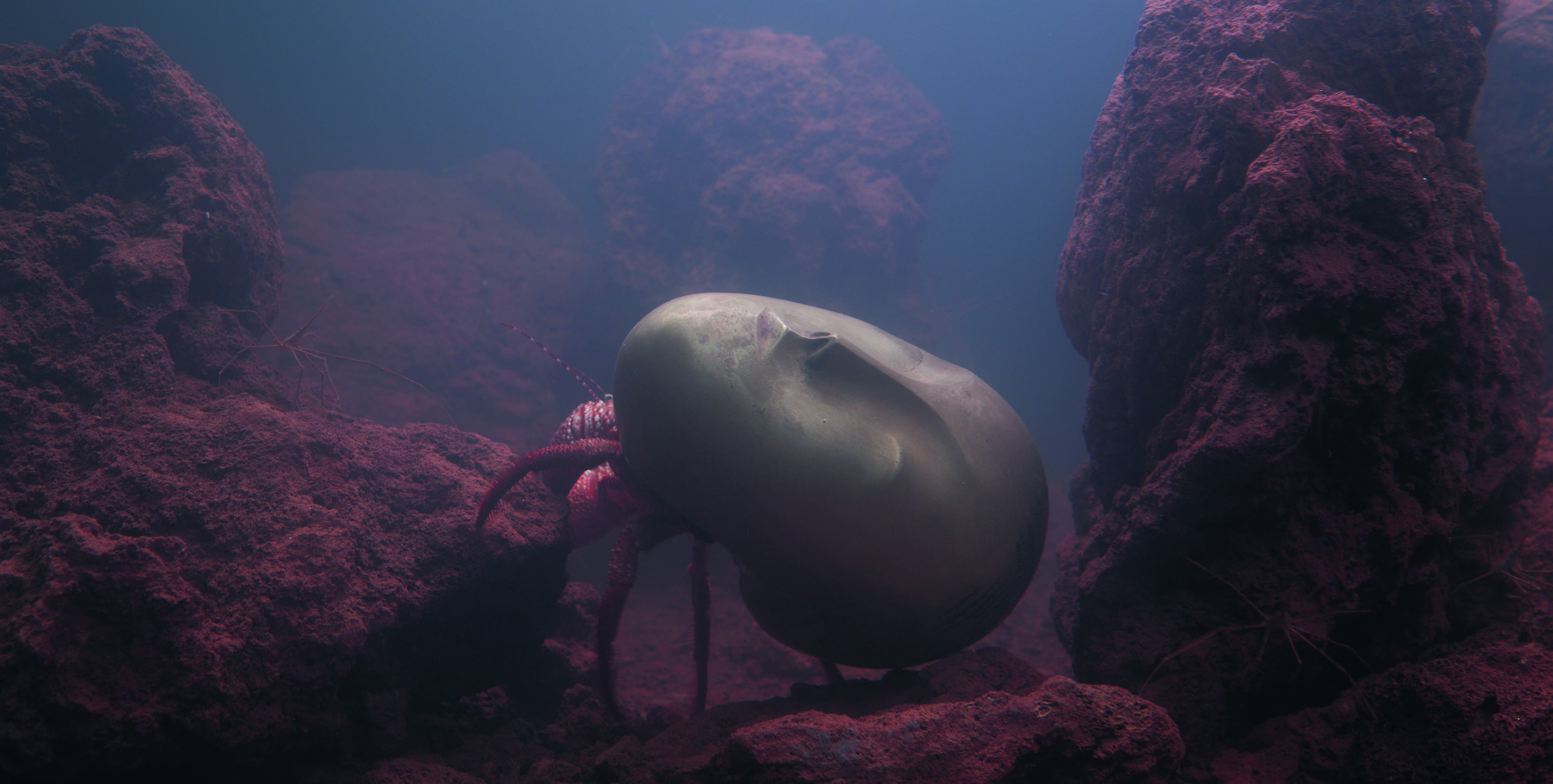
Pierre Huyghe, Zoodram 4, 2011. Living marine ecosystem, aquarium, filtration system, resin mask, 76 x 135 x 99 cm.
However, this aquatic medium associated with Huyghe’s name – sealed, enclosed – develops from one moment to the next independently of both artist or spectator. Human intervention is minimal. Artistic intention is absent, participatory engagement of the spectator equally so. Every element contained within the limits of the aquarium (itself contained within the larger limits of the exposition) is not a simple object, but the subject of its own encounters.
Spontaneous and unpredictable, the elements alter reciprocally in the absence of an exterior factor: the aquarium glass imposes form on the body of water; the crab transforms the Muse’s figure into a dwelling, moving it from place to place; the crab’s activity is limited and determined by the spatial positioning of the stones; grains of sand raised by movement are carried pendulum-like by the rhythms in the water; and so on. An entire dance of events thus takes place, and from this dance the anthropic element is absent. Such a situation then proposes a set of questions: How much control does the artist have over their own artwork? And, consequently, enlarging the scope, how much control does humanity have over nature? Finally, the question remains: How human is that?
In a similar vein, the Polish artist Agnieszka Kurant exhibits the work of millions of termites in A.A.I. (2014). The project presents the insects’ capacity to build architectural and sculptural structures, demonstrating how the artist can delegate creative tasks to the broader domain of nature. By outsourcing artistic labor to termites, Kurant repositions these insects as mediators, as ambassadors of thought – translating abstract ideas into material form. The artist does not create the artwork directly but rather establishes conditions – a framework, a habitat – within which unpredictable forms emerge through the complex interweaving of human intention and nonhuman intervention.
Elsewhere, “certain photographs by Gabriel Orozco reproduce this entanglement between humans and things.”2 In Astroturf Constellation (2012), the Mexican artist gathers together aleatory objects found on an artificial grass sports field. Equally human and nonhuman, organic or artificial, left there intentionally or brought there by chance, lost or forgotten, fragments of a once-larger body or stand-alone entities, all these objects are the result of interaction between multiple agents. A chewed gum bearing the negative imprint of a molar, or a sunflower seed once carried by the wind or inside an amateur athlete’s pocket – these are all “clues to a dissolution of the human being within a universe where he or she is ubiquitous but disseminated among things.”3
Among such themes and practices delineated by the preceding sketches, we find Bruno Latour’s foundational observation in the opening pages of his influential work, Nous n’avons jamais été modernes (We Have Never Been Modern): “All of culture and all of nature get churned up again every day.”4
Considered through this lens of « entanglement », the projects of Huyghe, Kurant, and Orozco participate in a larger historical and critical trajectory articulated in A Questionnaire on Materialisms, published by the art theory and criticism journal October in 2016.5 The questionnaire addressed the influence that various theories and theoretical frameworks like Actor-Network Theory (Théorie de l’acteur-réseau), Object-Oriented Ontology, speculative realism, or vibrant materialism had on art-historical discourse and recent artistic orientations.6
The responses, highly diverse, demonstrate widespread familiarity within contemporary art discourse with theories falling under the umbrella term of New Materialism: a conception that attempts, among other things, to “think the reality of objects beyond human meanings and uses,” “asserting that humans and objects form networks or assemblages across which agency and even consciousness are distributed.”7
In general terms, New Materialism can be defined by posthumanist preoccupations, arguing in favor of the need to grant a certain degree of agency – historically reserved for humans alone – to matter, things, objects, or any types of living organisms or entities, all contained under the concept of the nonhuman. Along these lines, New Materialism seeks an enlargement of the importance of material qualities and properties beyond the significance they might have strictly from an anthropic perspective.
In art, the distinctive sign or characteristic of artworks that register within New Materialist discourse can be summarized as the dissolution of the distinction between creator and creation. More simply put: the artist is no longer considered the unique and sole creator of the artworks they sign but rather becomes a co-actant, collaborator, or co-producer of the art piece, joining a larger assemblage that includes all elements and material conditions.
The general structure of metaphysics – indifferent to its position, whether sitting under idealism’s designation or associated with old (classical) materialism – maintained that matter is inert, passive, and devoid of meaning and signification. The idea of matter’s passivity was defining in developing “[m]odern materialism” – represented by figures like Francis Bacon, René Descartes, or Thomas Hobbes – “insofar as matter is what is caused or moved by something else: vital and causal forces or natural laws of motion.”8 In other words, matter was not in such instances creative or expressive in itself, was not thought to be endowed with agency or autodeterminacy, but rather moved from outside itself, in relation to which it becomes dependent to have any meaning.
Conceived as a finite and closed-off system, constituted of length, width, height, and thickness, matter was rendered measurable and controllable. And the privileged capacities of language and reason – through which humanity differentiated itself from all things (and, implicitly, animals) – conferred upon the human subject the privileged position of external observer, the vantage point from which measurement and control could be exercised.9
Such preconceptions have founded modern ideas of matter and materiality as something over which the human (and only the human), from its vantage point, can impose its will, assuming itself capable “to access matter’s true nature or essence.”10
Against these now obsolete principles, New Materialism objects, suggesting instead that there exists “an excess, force, vitality, relationality, or difference that renders matter active, self-creative, productive, unpredictable.”11 Thus, New Materialism’s goal is to operate a “Copernican counterrevolution” on the grounds that there is no longer any reason to limit the ontological varieties that matter to two.”12
The orientation toward the binarity against which New Materialism objects is owed in large part to the Cartesian philosophical program. Cartesian dualism divides the world into two principal substances: on one hand, there is the thinking substance (res cogitans), quated with the human intellect which, endowed with the privilege of reason and language, assumes the function of an external observer and, in consequence, imposes itself upon and remains unaltered by the extended substance (res extensa), associated with the body and with matter.
Maintained over time, this binary logic was extended such that our conceptions of the world – the essential framework of modern thought – operate through oppositional pairs: good/bad, masculine/feminine, master/slave, culture/nature, etc. We may observe that, much as the thinking thing is positioned as superior to the extended thing, so too in these other pairs one term (or element) subordinates the other, functioning, so to speak, as its “positive” counterpart.
Of all these pairs, the last – culture/nature – proves to be the most important and illustrative. This is because the concept of culture postulates that the human (civilized), as possessor of reason and scientific knowledge, is able to dominate nature (savage, uncivilized) and its derivatives.
Another significant oppositional pair to consider, following from the preceding one, is that of subject/object. The subject, in its relation to the object, occupies a position of advantage, being the one that initiates, moves, modifies, influences, and exercises power over the object. In other words, the subject – most often thought of as human – is the one that, within this relation, possesses agency, proving its capacity to act, to take action. The object – most often belonging to the material, nonhuman domain – is, as follows from the above, inert and passive: that which is acted upon.
Against such limitations, and in an effort to revise the rules of classification, Bruno Latour proposes the term “nonhuman”, which “is intended to signal dissatisfaction with the philosophical tradition in which an object is automatically placed opposite a subject, and the two are treated as radically different.”13 In We Have Never Been Modern, “nonhumanity” refers to “things, objects, beasts”;14 while in the introduction to publication Reassembling the Social (originally published in English), the term is articulated through the juxtaposition of entities such as “microbes, scallops, rocks, and ships.”15 (Among these enumerations we find, accidentally yet convincingly, some of the elements that compose Huyghe’s work mentioned at the beginning.)
The term nonhuman, unspecialized and of broad utility, refers to the nature of the described thing rather than to the position it occupies in relation to another thing (whether human or nonhuman). But, since “action is always « interaction » – which is to say that it is shared with variable actors, of variable ontologies, of variable times, of variable spaces, and of variable durability,”16 New Materialism, as a philosophy of processes and actions, operates with other concepts whose use diminishes the anthropocentric baggage of the subject/object distinction.
First, as mentioned earlier, the distinction at the level of interaction is made between actor and actant: “An « actor » in ANT is a semiotic definition […] that is something that acts or to which activity is granted by others. It implies no special motivation of human individual actors, nor of humans in general. An actant can literally be anything provided it is granted to be the source of an action.”17 It should be noted that nothing in these definitions indicates that they refer strictly to humans. In contrast to more classical definitions – the ones that are, for example, grounded in the term’s etymology (Lat. āctor, “doer”) – the anthropic aspect is exceeded.
The ambivalence of the term’s applicability – an actor can be either human or nonhuman, just as an actant can be human or nonhuman – aligns with symmetric anthropology’s effort to overcome Cartesian dualism through the proposition of a different conception of agency, one that encompasses all entities that make or promote a difference in another entity or within a system.
Closely related to the concept of the actant, the simplicity of the term intermediary is complemented by the term mediator. Intermediaries, functioning as general surrogates, are elements (parts of a network or course of action) that, at the level of interaction, do not contribute significantly to its mode of development – an intermediary is “a placeholder in the sense in which it merely does what anything else in its position would do.”18 The function accomplished by an element described as intermediary could be accomplished by another element that is similar, possessing comparable properties or structure.
For example, when someone’s goal is to note something quickly in writing, a napkin may prove to be as useful as any other piece of paper: for this purpose, the napkin and the sheet paper function as intermediaries, simple means to achieve a much more important goal – that of writing, regardless of how, which takes precedence. Differently from an intermediary, a mediator brings a significant contribution to the way the interaction unfolds: “however, conceived as mediator, a nonhuman is necessarily seen as adding something to a chain of interaction or an association.”19 Mediators thus modify the course of action in unpredictable, novel, and unforeseen ways through their special and unique configuration.
As our model for this, we will turn to prehistoric cave art – specifically the Red Cow and First Chinese Horse drawings from Lascaux. Observing the animal figure on the left, we encounter a multiplicity of contours: the lines composing its meaty back have, first, been repeated and restarted and, second, fractured. The main, final line – appearing almost as a compromise of the artist – is not smooth but broken, affected by the texture of the cave wall. Its course may be compared to that of a river that follows the topography of an existing valley.
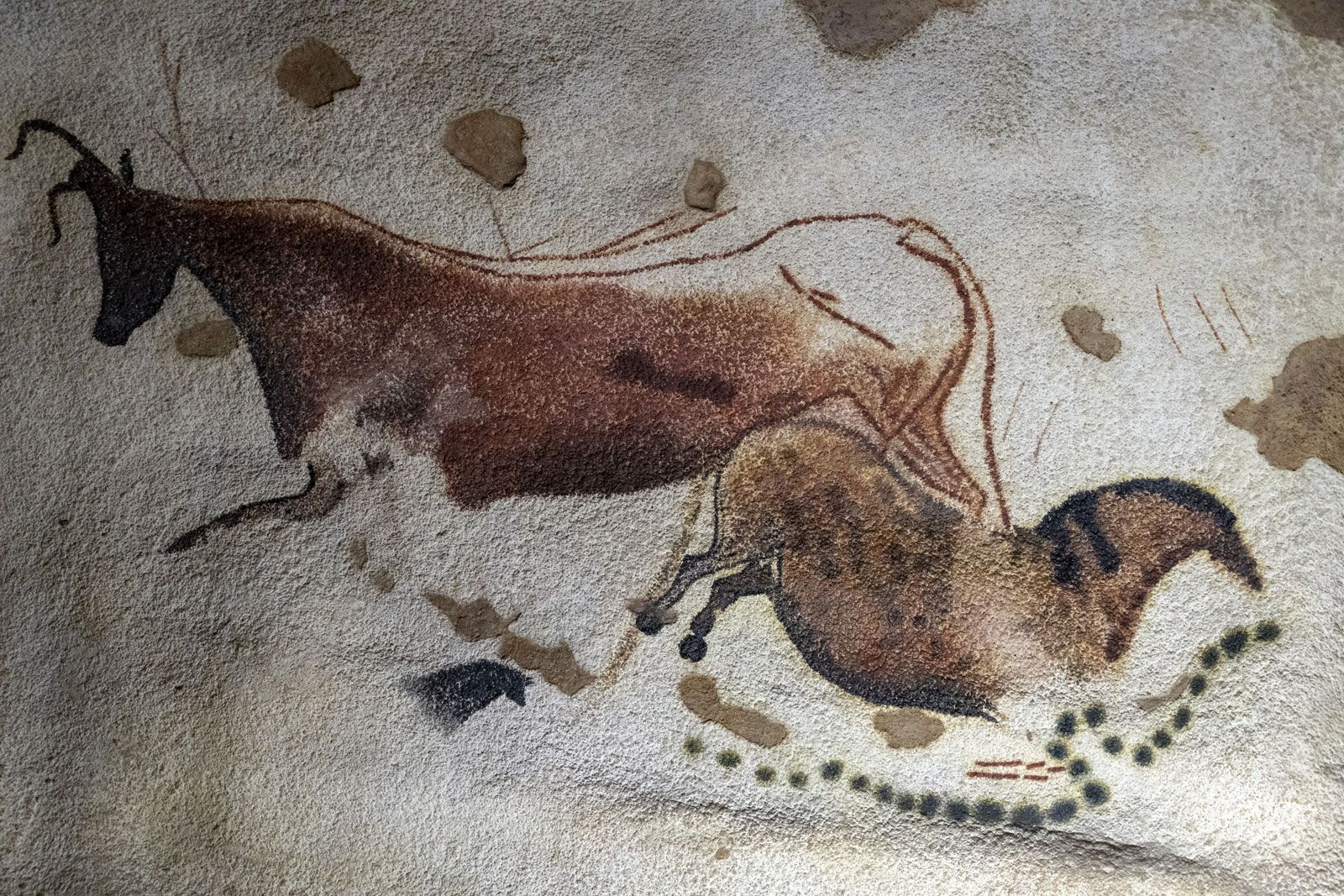
Red Cow and first Chinese Horse, Lascaux Cave, France.
As our model for this, we will turn to prehistoric cave art – specifically the Red Cow and First Chinese Horse drawing from Lascaux. Observing the animal figure on the left (representing an aurochs), we encounter a multiplicity of contours: the lines composing its meaty back have, first, been repeated and restarted and, second, fractured. The main, final line – appearing almost as a compromise of the artist – is not smooth but broken, affected by the texture of the cave wall. Its course may be compared to that of a river that follows the topography of an existing valley. The line fills in the crevices of the wall.
A mark – whether bodily, an indentation in a cave wall, or a scratch on an instrument’s edge – acts as a map of the incident: “Our objects remember, they carry material memories in their marks, both those we consider artistic and those that we dismiss as simply the residue of past actions.”20 These marks, relationally emergent through the complex interweaving of human intention and nonhuman intervention, can thus be read as maps through which a past event becomes legible.
In the case of the Lascaux paintings, the event-like dimension of the work – situated both at the beginning, the middle and at the end of a trajectory – suggests that the whole creative act unfolded at the level of the wall, through direct contact with it: tactile, haptic. As an obstacle that modifies the action of the bodies that encounter it, the wall’s material properties functioned as an actant, influencing both the development of the action and its outcome.
In the adjacent diagram, the hand (representing the human aspect, the actor in this case) holds a piece of stone21 – an extension of touch, perceived through vibration – with which it scratches the surface of the cave wall (both the stone and the wall represent nonhuman aspects). The movement of the hand – represented by the dotted line – although it may have been intended as a straight line (or smooth line in any case), is disrupted by the vibrations produced by the irregular surface, by the contact between the form of the held stone and its encounter with the wall. The movement of the hand mirrors the surface of the wall.
If we imagine that the prehistoric artist intended to draw a straight line, or a line closer in appearance to the final form in the Lascaux example – one that the other two abandoned attempts did not closely or adequately match – such a line could not have been actualized because of the medium/surface on which it was expressed. Compared to an ideal form – i.e. the virtual image of the abstracted animal figure – the actualization is “deficit.”

Diagram illustrating the effects of the wall’s texture on hand movement.
Matter, in this case, is enactive; from the position of the actant, the medium/surface proposes modes of action, opening new courses for the gesture. The cave wall and the stone (the medium and the instrument) thus function as mediators, and not simply as intermediaries in the expression of the imagined animal form.
As we stated before – and as we repeat here – the concept of the intermediary designates a thing that fulfills a function that any other thing (approximately similar in its properties) could also fulfill in its place: one might imagine that, instead of the parietal support of the cave, the image could have been expressed on a modern canvas or on paper. Because of their planar, non-accidental surfaces, these media would have intervened less in the actualization of the drawing.
By functioning as mediators, however, the cave wall and the stone are more than simply substitutable things; they are suppliers of actions that profoundly modify the actualization of the event and, as a result, the finality of the cave painting.
The meeting between the stone and the cave wall takes place at a haptic level. We must understand that touch has perceptible consequences in the development of subsequent actions. It is through such examples that we understand nature’s contribution to the artistic pursuit, and we understand the trajectory of thought imposed by matter.
These ideas resonate with Daniel Buren’s concept of the In Situ,22 which proposes that an artwork’s spatial context – of creation or exhibition, whether the artist’s studio23 or, in our case, the cave wall –inscribes it with meaning. Spatial conditions are not merely the gaps between artworks, the backdrop against which they are perceived; they also encompass material and relational elements within the work itself, including those not immediately evident. In this sense, we might distinguish two “sites”: the one inside the artwork, and the one around it. The cave wall functions as a spatial mediator: its texture, form, and topology are not passive supports but active participants, shaping lines, gestures, and haptic interactions as they unfold. This parallel will be taken up in the following part, later.
- Sven Lütticken, „Abstract Habitats: Installations of Coexistence and Coevolution”, Grey Room, no. 59, 2015, p. 117. ↩︎
- Nicolas Bourriaud, Inclusions. Aesthetics of the Capitalocene, London, Sternberg Press, 2022, p. 68. ↩︎
- Idem. ↩︎
- Bruno Latour, We Have Never Been Modern, Cambridge, Harvard University Press, 1993, p. 2. ↩︎
- David Joselit et al. „A Questionnaire on Materialisms”, October, vol. 155, 2016, pp. 3-110. ↩︎
- Ibidem, p. 3. ↩︎
- Idem. ↩︎
- Christopher N. Gamble, Joshua S. Hanan & Thomas Nail, “What Is New Materialism?”, Angelaki, Vol. 24, No. 6, 2019, p. 116. ↩︎
- Ibidem, p. 115. ↩︎
- Ibidem, p. 113. ↩︎
- Diana Coole & Samantha Frost (eds.), New Materialisms. Ontology, Agency, and Politics, Durham, Duke University Press, 2010, p. 9. ↩︎
- Bruno Latour, op. cit., p. 79. ↩︎
- Edwin Sayes, „Actor-Network Theory and methodology: Just what does it mean to say that nonhumans have agency?”, Social Studies of Science, vol. 44, no. 1, 2014, p. 136. ↩︎
- Bruno Latour, op. cit., p. 13. ↩︎
- Bruno Latour, Reassembling the Social. An Introduction to Actor-Network-Theory, New York, Oxford University Press, 2005, p. 10. ↩︎
- Edwin Sayes, art. cit., p. 140. ↩︎
- Bruno Latour, „On actor-network theory: A few clarifications”, Soziale Welt, 47 Jahrg., H. 4, 1996, p. 373.
It should be noted that the two concepts, actor and actant, are sometimes used interchangeably. For our purposes, however, a useful distinction emerges: an actor can be understood as the origin of action, while an actant is that which affects or modifies action. This distinction matters because, within ANT, nothing acts independently – everything operates within networks where agency is distributed and relational. ↩︎ - Edwin Sayes, art. cit., p. 138. ↩︎
- Idem. ↩︎
- Christina Tsoraki et al., “Making marks meaningful: new materialism and the microwear assemblage”, World Archaeology, vol. 52, 2020, p. 507. ↩︎
- It must be noted that the Lascaux paintings were created using mineral pigments applied through various techniques including fingers and primitive brushes. ↩︎
- “[A] term that he may have been the first to use in the early sixties, and that later would become known as the « site specific »”, Daniel Birnbaum & Sven-Olov Wallenstein, Spacing Philosophy: Lyotard and the Idea of the Exhibition, Berlin, Sternberg Press, 2019, p. 54. ↩︎
- See Daniel Buren & Thomas Repensek, “The Function of the Studio”, October, vol. 10, 1979, pp. 51-58. ↩︎
 Boundary Issues