
Boccioni after Ernst; or Boccioni: after Ernst. It is worth clarifying the syntactic ambiguity produced by the possible and deliberate presence of the colon – the double sense the title achieves depending on its presence. First, it refers to the chronological placement of the two artists. The work of Max Ernst under consideration here postdates that of Umberto Boccioni by approximately twenty-five years. This temporal sequence also determines the order in which we will address them in what follows. Second, and more significantly, the colon might open another reading: implying an understanding of Boccioni’s work through the lens of Ernst’s (relatively) subsequent contribution to art history. The prewar Boccioni understood by his contemporaries differs from the Boccioni legible to us today – a Boccioni read after Ernst, through Ernst, because of Ernst.
Thus, we find ourselves, from the outset, on a battlefield of ideas. Among conflicts between pairs and rivals. What follows concerns war and the two antithetical principal forms that dominated avant-garde movements in the first half of the twentieth century: the mechanical and the primitive. The reason for this inquiry – that is, our thesis – lies in resolving a (personal) dilemma regarding the affinities between Umberto Boccioni’s Unique Forms of Continuity in Space, 1913, Futurism, and Max Ernst’s The Triumph of Surrealism, 1937, Surrealism. While these affinities are initially formalist in nature, they prove to be equally conceptual upon closer examination. The question that will guide us throughout this investigation is whether these two works can constitute a pendant, a pair.
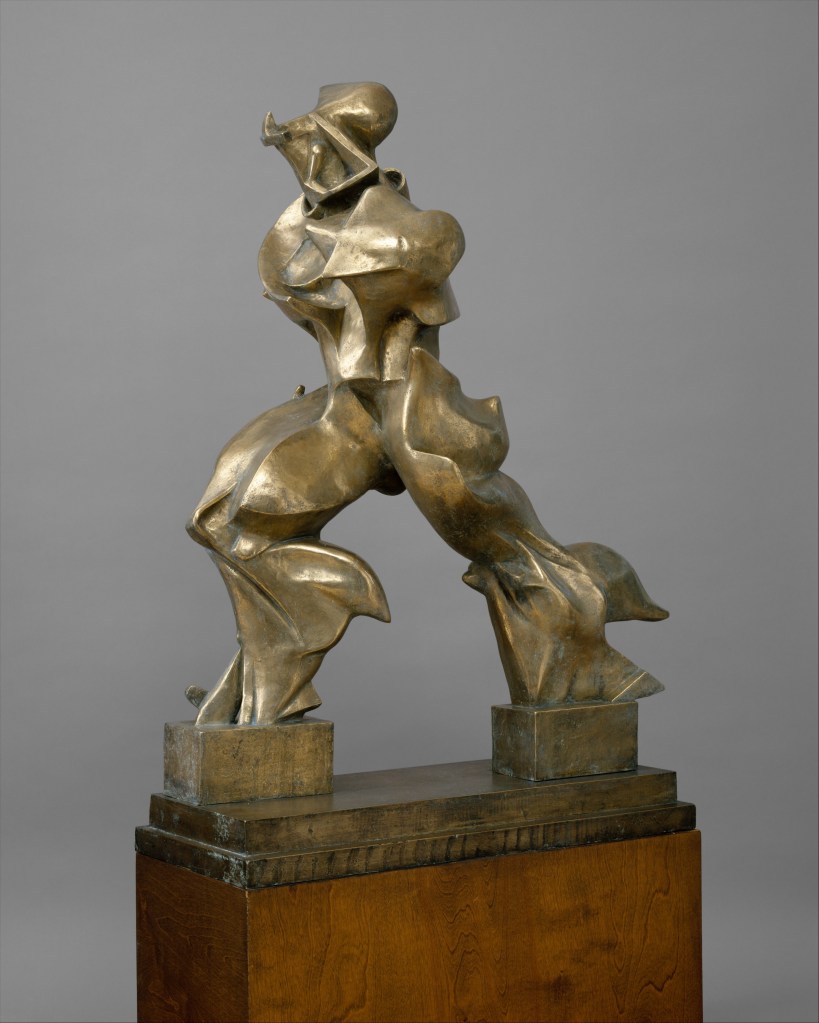
Umberto Boccioni, Forme uniche della continuità nello spazio (Unique Forms of Continuity in Space), 1917 (1950). Bronze, 121,3 x 88,9 x 40 cm. The Metropolitan Museum of Art, New York.
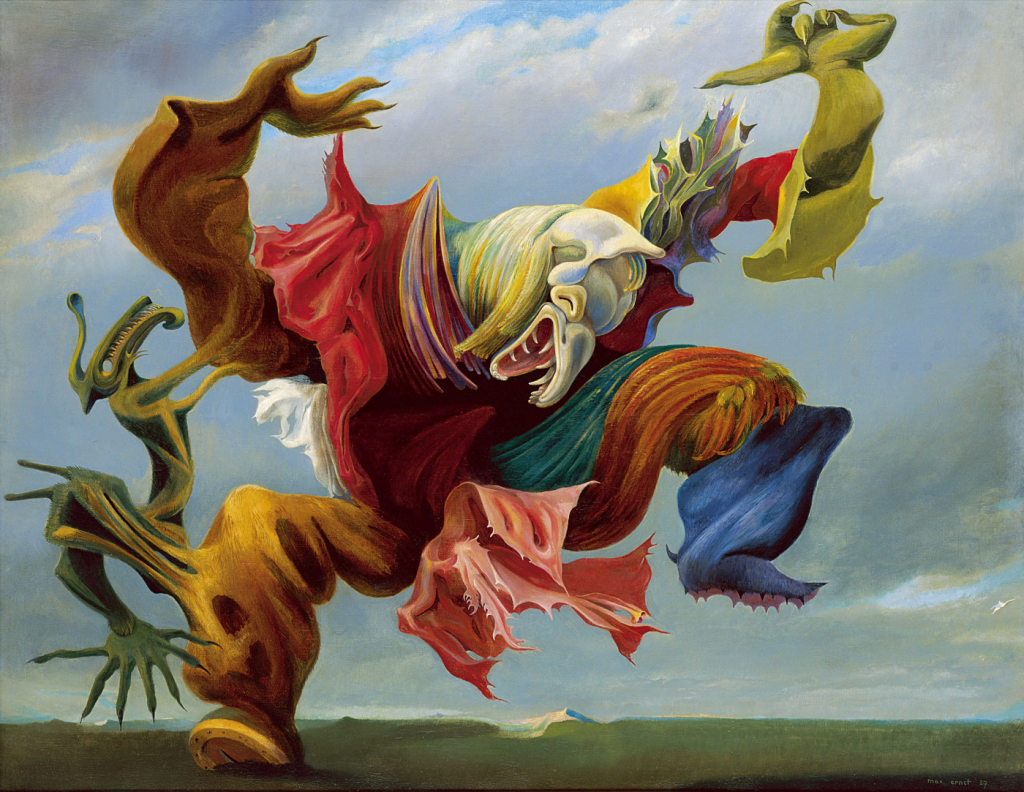
Max Ernst, Der Hausengel / L’Ange du foyer orLe triomphe du surréalisme (The Triumph of Surrealism), 1937. Oil on canvas, 114 x 146 cm. Private collection.
When Marinetti published his Futurist Manifesto in the Parisian newspaper Le Figaro on February 20, 1909, he announced to the world his unequivocal love for war – “the world’s only hygiene” – and radically affirmed that “[a] racing car whose hood is adorned with great pipes, like serpents of explosive breath – a roaring car that seems to ride on grapeshot is more beautiful than the Victory of Samothrace.”1
The favorable opinions and praise Marinetti lavished upon the new mechanical medium were, in essence, founded on a Darwinist logic. As he himself enunciated inL’Uomo multiplicato e il Regno della macchina (Multiplied Man and the Reign of the Machine): dormant wings awaited “to be awakened within the flesh of man.”2 Through the contribution of technics, man was to become, like the centaur, a hybrid: half-man, half-machine.
Yet despite this creative fervor, Marinetti was not an artist in the plastic sense, but a writer. It fell to others to transpose his ideal – his mechanolatry – into visual form.
Futurism’s quintessential work – and the sculpture Boccioni considered to be his finest – entitled Forme uniche della continuità nello spazio (Unique Forms of Continuity in Space), perfectly illustrates the artistic objectives of the Futurist art movement, concretely embodying its programmatic theories. (It might be noted that Boccioni – who was primarily trained as a painter – wrote the theoretical foundations of Futurist sculpture before sculpting the Unique Forms, so theory predates practice in a sense.)
The sculpture presents an amphibious figure, half human, half machine – a centaur, a robot, a cyborg – illustrating the fusion of the human body with its newly mechanized environment. The result: an image of speed and progress. It lacks both a discernible face and arms, recalling in this respect the Victory of Samothrace invoked by Marinetti in his initial manifesto. And it also recalls Auguste Rodin’s L’homme qui marche (The Walking Man, 1907): both formally and conceptually.
In what way? Beyond the stepping, advancing action both figures perform, Rodin’s sculpture likewise demonstrates hybridization: the torso was welded to the legs (or the other way around), the two distinct elements belonging originally to separate sculptures.
To digress briefly on the subject of Rodin’s sculpture: the concept behind it also invokes – given our present concern with war – the corporeal “repair” of the body on the battlefield: a display of amputations, sutures, scars, bruises, wounds.
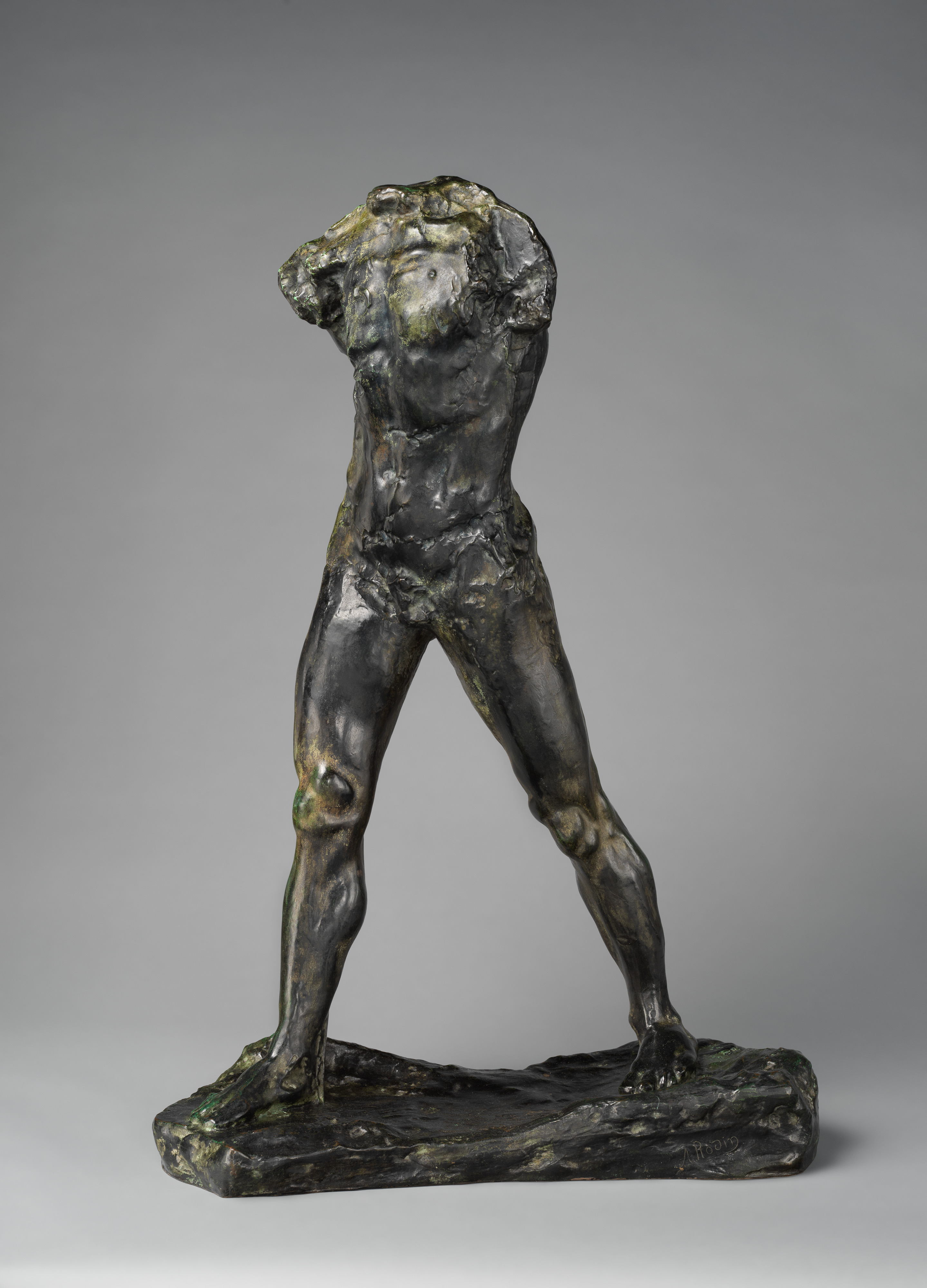
Auguste Rodin, L’homme qui marche (Omul care merge), cca. 1895-1900 (cca. 1914). Bronz, 85,1 cm. The Metropolitan Museum of Art, New York.
Kader Attia’s 2010 installation, Open Your Eyes, intelligently articulates the intersection between the mechanical and the primitive faced with the disasters and effects of war and conflict. In one of the slides of the installation – the one presented here, but there are others – , we are presented with photographs of World War I soldiers with facial injuries; their reconstructed faces, repaired under unsanitary conditions, bear striking resemblance to “primitive”, extra-Occidental masks. Cult objects that themselves display improvised repairs following their destruction—both literal and metaphorical—at the hands of colonial forces. The installation thus traces a parallel between destruction wrought by mechanical warfare and the destruction of “primitive” (essentially human) elements: a symmetry between the loss of the sacred and the devaluation of human life.
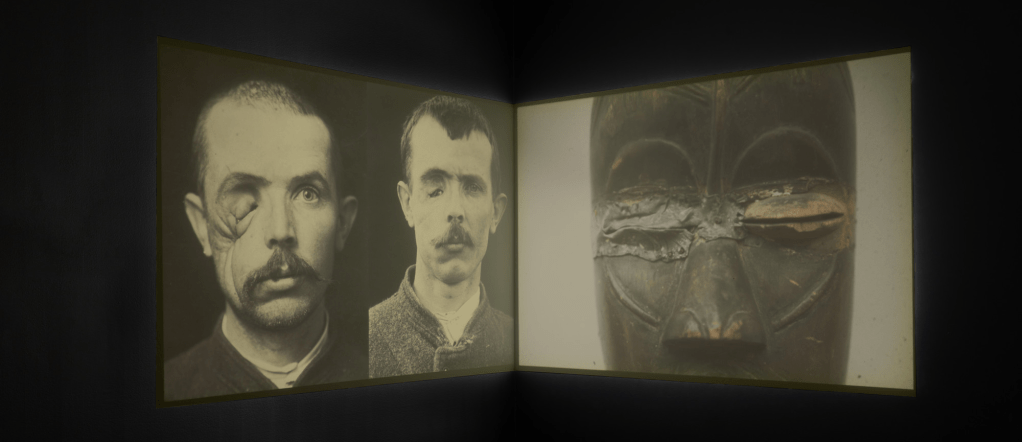
Kader Attia, Open Your Eyes, 2010. Two sets of eighty 35mm black and white and color slides, 160 x 260 cm. Museum of Modern Art, New York.
Returning to Boccioni’s sculpture, we observe its elegant androgynous body, composed of curved lines that, though wingless, appears ready and capable of flight – to glide, to move with a speed and impetuosity unknown to mere mortals. The otherwise immobile figure’s aerodynamic aspect compels the viewer toward an eidetic projection of spatial passage. The open chest evokes avian forms, and we must remember that the mechanical – the airplane and the train – imitates forms found in nature. Thus, in a process analogous to the engineering of an aircraft, technology in Boccioni’s sculptural example has reformed the anthropomorphic figure, endowing it with new capacities designed to meet the exigencies of the newly industrialized world: to withstand the shock of perpetual change and acceleration.
Contained within the sculpture is not merely the presentation of movement in space-time – a question deeply considered by the Futurists3 – but a complete transformation, a metamorphosis, a becoming. As Boccioni states: “To render a body in motion, I definitely do not present the trajectory, that is, the passage from one state of repose to another state of repose, but force myself to ascertain the form that expresses continuity in space.”4 So, if we are to understand this correctly, the question was not to represent the start and finish of an action, nor merely the/any moment between these two states, but all states simultaneously: start – process(es) – finish.
The becoming-machine of man is thus capable of confronting the strong wind5 that meets the figure head-on: for there exists this counter-illusion, the visible effort the figure exerts to push forward against resistance. It is capable of conquering it, winning distance and space against it.
That such a sculpture came to represent progress in the eyes of Boccioni and other members of the Futurist movement is hardly difficult to grasp. In 1913, while Futurist fervor remained palpable in Marinetti’s caustic pronouncements, mechanized warfare was known to Europeans only through the idealized images and memories of victors. The military airplane had been introduced by the Italians in Libya during the Italo-Turkish War for North Africa. The figure of the machinegun pilot deeply integrated into the machinery of the airplane – as the ideal war machine – dominated the imperialist European imaginary.
This masculine, phallic imaginary of the airplane’s machine gun was invoked by Marinetti in Uccidiamo il chiaro di luna! (Let’s Murder the Moonlight!): “Ho fra i piedi una minuscola mitragliatrice, che posso scaricare premendo un bottone d’acciaio…” (And between my feet I have a tiny machine gun that I can discharge by pressing a steel button…).6 Read through a psychoanalytic lens, this new machine gun technology, overtly masculine in character, functioned as a prosthesis – a defense against the castration complex theorized by Freud. This phallic conception of technology and machinery helps explain Marinetti’s crass misogyny and frequent attacks on women. He believed – or perhaps hoped – that technology would enable men to procreate without women; such a scenario appears in Mafarka, a Futurist novel by the Italian writer.7
Inevitably, Europe would come to experience this devastating new form of warfare firsthand. The semiotic ambiguity of Boccioni’s sculpture lends itself perfectly to the following interpretation: as spectators, we can encounter the sculpture in two ways owing to its three-dimensionality. First, we can position ourselves such that it appears to advance toward the right – a direction that, within European culture and thought, symbolizes progress.8 Alternatively, we can position ourselves such that it appears to move leftward: the symbol of regression. Technology – or rather, the transformation of man under the influence of technology – thus possesses a double valence: an evolutionary, transformative, constructive sense, and an involutionary, destructive one. The benefits of technology when forcing war against others, the devastation of war when the same technology is turned against you.
Jacob Epstein’s Vorticist Rock Drill – and especially its accidental history – perfectly illustrates the shock of modern technological warfare’s arrival on the Old Continent. The (1973-4) reconstruction of the original 1913 work, predating World War I, is a readymade (coincidentally appearing the same year as Duchamp’s Bicycle Wheel): the embryonic, emaciated figure with its elongated limbs stands atop a real and functional rock drill. This drill plays exactly – and perhaps coincidentally – he role of the phallic machine-gun mentioned previously: a symbol of violent and penetrative virility. A functional assemblage is thus constructed of human body and machinery.
But essential to this Vorticist intervention is understanding what happened to the artwork once Epstein himself grasped the destructive logic of war. In 1915, when World War I’s atrocities were already well known across the Continent, the idea behind the sculpture was repudiated. The result: the figure was disarmed, dismounted – that is, castrated – sectioned, amputated, and placed on a pedestal as a captured trophy, resembling the torso of a fallen soldier on the battlefield, the cadaver of a captured enemy. The one who once enacted the killing became, in turn, the victim of his own hubris.9
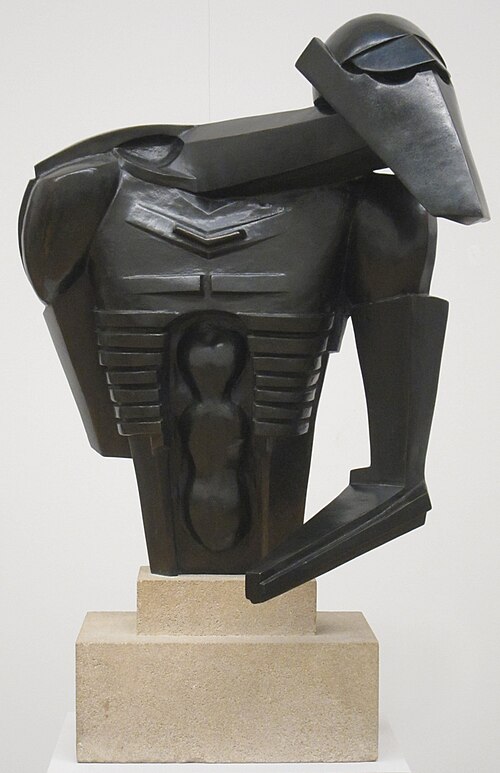
Jacob Epstein, Torso in Metal from ‘The Rock Drill’, 1913-15. Bronz, 70,5 x 58,4 x 44,5 cm. Tate Modern, London.
Turning to Max Ernst, we are again confronted by the question of war. If the Futurists’ fascination with war is more or less evident now, then he Surrealists’ aversion to it will become equally comprehensible. The Surrealists were critical of the machine ideal and opposed to the fascist military conception of the body-becoming-weapon.
Examining Ernst’s 1937 painting The Triumph of Surrealism, we must consider the context of its appearance. The year itself offers indications: it is the same year Picasso painted Guernica. If we are even minimally familiar with the Spanish artist’s painting, then we already know something essential about Ernst’s work as well. We must direct our gaze to Spain.
In February 1936, the Popular Front of Spain – a coalition composed of the country’s left-wing parties – won the elections. In July of the same year, General Francisco Franco assumed leadership of a nationalist revolt that initiated the Spanish Civil War, fought between Franco’s Nationalists (the army, the church, the industrialists) and the Republicans (socialists, communists, anarchists, Catalans, and Basques). From outside Spain, Hitler and Mussolini offered substantial cross-border support to the Nationalist forces, while Stalin, from whom aid was expected for the Republican cause, proved far less committed. International brigades and left-leaning volunteers attempted to compensate for this lack of support. And under these conditions, the Nationalists ultimately prevailed. A story recounts how Max Ernst, deeply committed to the Republican cause and wanting to help – being personally familiar with war and conflict, having fought in World War I – presented himself before the Spanish Republican recruiters stationed in France: “Max Ernst was sufficiently disturbed by the outbreak of civil war in Spain to offer his services, as a former artillery officer, to the Republican authorities. (André Malraux, who was in charge of recruiting in France, is said to have regarded the offer as a joke: in any case, it was turned down.)”10 Under such circumstances, Ernst’s efforts were redirected toward art.
While L’Ange du foyer / Der Hausengel, translating to The Angel of Hearth and Home, was the initial title of the artwork, the German artist changed it during the 1938 International Surrealist Exhibition, renaming it The Triumph of Surrealism – an ironic title, mirroring the sardonic grin of the figure captured within the canvas, betraying the Surrealists’ (most of them holding left-leaning political ideals) powerlessness against the Fascism spreading across Europe.
Placed in the foreground, between the spectator and the horizon,11 a fantastical creature spasmodically throws its arms and feet into the air, seized by the force of wind. This wind causes total distortion of the creature’s anatomy: the moment captured (a snapshot) in the painting presents the creature in an appearance that would be lost with the passing of time (with a change in wind direction). The gusts model the textile-like material, rendering evident the ephemerality of the creature’s composition and, correspondingly, its psychological instability.
A secondary character grows out of the primary one, or forcefully clings to it, creating a point of tension within the pictorial event. This second figure might symbolize the cancerous nature of Fascism. Its color reinforces this interpretation: the cancerous figure possesses a morbid hue, and through the points of attachment it transfers this pallor to the primary figure’s body, affecting its own vibrancy. It is an infection. The main figure’s colors are more vibrant on its left side, away from the grasping parasite, than on its right, which appears paler.
Considering the conditions outlined above, and acknowledging that the two figures belonging to Boccioni and Ernst respectively are figuratively similar, what merits further comparison is their respective movements and the reasons for their creation.
Concerning Boccioni’s sculpture, it betrays a certain hubristic certainty. Its head is held high. The figure appears assured in its movements, and these movements possess reason, objective. The virtual destination toward which it advances is determined by its orientation: a fixed point. The movement appears governed by an interior power exteriorized to achieve a goal. The wind, though domineering, is entirely conquered – the figure, as avatar of the airplane, introduces spatially the idea that man conquers nature through the complicity of the newly mechanized medium. As Hal Foster summerizes: “Yet the fantasy is most extreme in movements like Futurism that aspire to technologize nature and to naturalize technology.”12
Ernst’s figure, by contrast, is disoriented and deranged, affected by the exterior force of the same wind motif – moved by natural elements rather than interior will, or influenced into performing spasmodic, chaotic movements by the cancerous figure of Fascism. The motif of flight appears here as well, but dissimilar to the solid body of Boccioni’s figure, the textile body – invoking torn national flags, broken national ideals – moves segmentally, each part animated toward a different objective, by a different reason. Each segment is independent from the others. The self is divided. In this creature we recognize charm, but also madness – an essential Surrealist dyad.
Boccioni’s figure celebrates machinism, speed, and war, awaiting the gratification of its senses through military conflict and conquest. Ernst’s figure, meanwhile, portrays the erratic nature of speed, the instability of the nationalistic war machine, and the devastation of war.
- Filippo Tommaso Marinetti, “The Founding and Manifesto of Futurism”, 1909. In Lawrence Rainey et al. (eds.), Futurism. An Anthology, New Haven, Yale University Press, 2009, pp. 49-53. ↩︎
- Filippo Tommaso Marinetti, “Multiplied Man and the Reign of the Machine”, 1911. In Lawrence Rainey et al. (eds.), Futurism. An Anthology, New Haven, Yale University Press, 2009, pp. 89-92. ↩︎
- The dynamic technique of temporal compression employed by the Futurists was called “simultaneity”. ↩︎
- Ester Coen, Umberto Boccioni, New York, The Metropolitan Museum of Art, 1988, p. XXIX ↩︎
- Wind as metonym for nature itself. ↩︎
- Filippo Tommaso Marinetti, Uccidiamo il Chiaro di Luna!. In Filippo Tommaso Marinetti et al., I Manifesti del futurismo, Firenze, Lacerba, 1914, pp. 11-22. / Filippo Tommaso Marinetti, “Let’s Murder the Moonlight!”, 1909. In Lawrence Rainey et al. (eds.), Futurism. An Anthology, New Haven, Yale University Press, 2009, pp. 54-61. ↩︎
- Originally published in French in 1909 as Mafarka le futuriste: Roman africain, Marinetti’s first novel was written concurrently with the Futurist Manifesto of that year. The novel was translated into Italian in 1910 not by Marinetti himself but by Decio Cinti, his private secretary. ↩︎
- For example, the direction of writing, from left to right, enacts a progressive movement across the page – an exploration, a covering, a “colonization” of space. ↩︎
- For details, see Richard Cork, Jacob Epstein, London, Tate Gallery Publishing, 1999, pp. 38-40. ↩︎
- John Russell, Max Ernst. Life and Work, New York, Harry N. Abrams Inc., 1967, p. 120. ↩︎
- The horizon was one of the emblematic elements of Surrealist painting: the landscape, a genre largely ignored during the twentieth century, playing a minor role in modernist practice. The Surrealists employed the horizon line to symbolize the infinite realm beyond finite and perceptible reality—the subconscious, the mystical, the transcendental. ↩︎
- Hal Foster, Prosthetic Gods, Cambridge, The MIT Press, 2004, p. 120. ↩︎
 Boundary Issues