
First and foremost, there’s the mouth: cut from an ad for Camel cigarettes and pasted onto the upper half of the empty canvas,1 this first form defines the rest of the pictorial space by way of position. Having a metonymic function, the mouth anchors the identity of the figure whose presence is announced through the title. Or it offers the otherwise abstract composition its figurative fulcrum through which all the distinct elements on the canvas – an assemblage of points, lines, and patches of color – become the interconnected parts of a common body. The eyes, the arms or legs, the breasts and the vulva, the hair, a smile: every bodily component of the feminine figure acquires its identity through the mouth’s relationship to it; by virtue of its placement on the canvas, on account of the ratio decided by location and distance.
The mouth mutely states, “A body stands here, or sits – my body, the body that carries me and to which I belong. Or which belongs to me.”
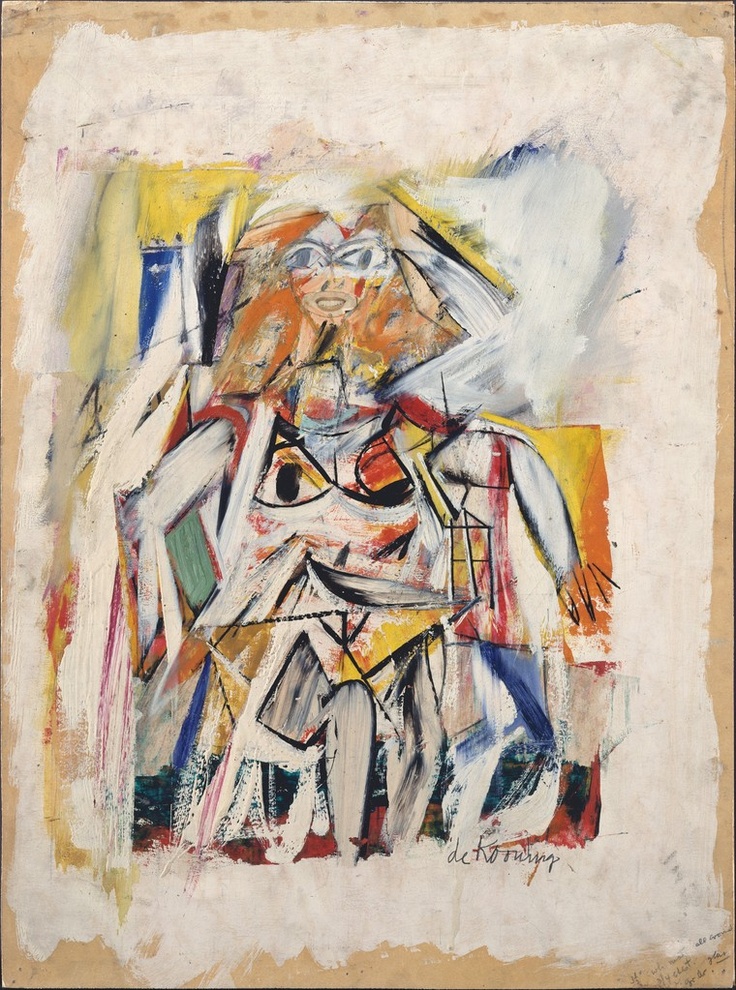
Willem de Kooning, Woman, c. 1952. Oil paint with cut and pasted printed paper on board, 45 × 33 cm. The Metropolitan Museum of Art, New York.
On these grounds, for the viewer, serving a navigational purpose, the mouth represents the starting point for unbundling the concept behind the painting. It acts as the point from which the spectator begins “reading” the image. Reconfiguring the rhythms of the encounter (between spectator and artwork), the mouth is the organizing center. All subsequent spatial relations on the canvas derive their meaning from this initial anchor’s placement.
But for the artist? The same mouth functioned differently: as a line of flight towards which the whole creative act headed and over which, once established (or, more precisely, pasted), he couldn’t come back. The mouth fixed the composition irreversibly. Everything else around it could be – and was – modified, reworked, or reclaimed; but not that original fragment, not that cut-out photographic mouth from a cigarette ad that anchored the becoming–woman of the soon-to-be Woman painting of 1952.
Through the addition of the initial photographic mouth segment in de Kooning’s work – the point of reference to which the creative act had to return daily, or had to not stray too far away from –, the announcement that warned us that the painter doesn’t actually sit before an empty canvas becomes true once again, and more evidently so: “If the painter were before a white surface, he – or she – could reproduce on it an external object functioning as a model.”2
With the exterior model missing, an interior starting point is thus established. This is how de Kooning went on to return to one of classical art’s most important subjects – „the idol, Venus, the nude.”3 And despite this return, the traditional roadmap of covering this great destination was ignored, or done away with. Because in de Kooning’s case, he didn’t work by order of reference, not mimetically that is. In the completed – by chance – painting, there isn’t an exterior subject to be found, the face or body of a once posing model, but rather a series of figural marks creating and holding an identity of their own that vaguely tend to resemble the classical concept of Venus (that’s rather implied or summoned) by their reducibility4 to the mouth: the artifice that secures the otherwise missing figurative functions.
Hence, dissimilar to the dominant process of the Renaissance – recovered after the obscurantism of the Middle Ages that “had forgotten the names of the famous artists of classical antiquity, and with their names it had forgotten their examples”, that is their “ability to imitate nature”5 – that required, for rendering such a subject, or for rendering the human body in general, the most beautiful leg, the most beautiful arm, the most attractive face, nature supplying the valuable examples that artists should use to reproduce and imitate,6 among de Kooning’s works such possibilities offered by nature were replaced by probabilities. Specifically, replaced by the fortuitous meeting of uncertain hands and vigorous matter.
As Harold Rosenberg noted regarding the artist’s paintings, “they are the products of his latest devices for circumventing his willful mind and trained hand.”7 That is to say, for de Kooning, the goal was, first, to not let the mind think the painting – future directions, current and eventual states, pursued finality – and, consequently, to not drive his hands to act according to what the mind dictates. Such was achieved by the closing of the eyes – an instance of a voluntarily forced blinding specific to the Abstract Expressionists –, the use of the left, non-dominant hand, or both hands at once, or by investing all attention to the television screen during the creative act: the screen, with its fast-moving images, transitioning from one frame to another, was not to let the mind dwell on one thing, any single “model”, for too long, disallowing the alliance of sight and memory from capturing formal details that the imagination could force upon the hands.
With the reference missing, the female figure – the whole painting less so the mouth – is the result of aleatory gestures, unintentional or, as the argument can be made, intended in action.8 he ambiguity of the figure, whether she is standing, sitting on a chair or lying down on her back,9 leaves no doubt that no initial development plan of the painting, a sketch or a (mental) project, can be tied to the representation of the Woman: proving that the painting was improvised from zeroes, restarting from a figuratively re-blanked surface every day.
Metaphorically, one can imagine de Kooning feigning the role of a dismissive amnesiac facing an illusory tabula rasa.10 Dismissing everything done on the canvas the days before, mentally ignoring – erasing – all content, de Kooning acknowledged no memory of the evidence laid before his eyes. Another forceful blindness. The canvas no longer presents a figure, the face of an old friend, but the back of a repudiated adversary.
We find in the case of de Kooning, as in the case of his Abstract Expressionist peers, the overcoming of the mimetic and teleological exigencies of art. Yet, unlike Pollock, in whose case the corporeal action was detached from the surface of the canvas, the gesture being therefore free (without material resistance, suspended in air), de Kooning’s strategy was rather to accentuate the haptic function. The touch – the direct encounter with the material – playing a much more important role, the main role even, in developing his artworks. Such material engagement exemplifies the sort of enactivism11 that suggests that artists (or humans in general) externalize their cognitive function, thinking through the material itself, aided by its properties.
In adopting this approach, Abstract Expressionism begins a world anew: “…it reverses the classical subordination, it subordinates the eye to the hand, it imposes the hand on the eye, and it replaces the horizon with a ground.”12
- Thomas B. Hess, Willem de Kooning, New York, The Museum of Modern Art, 1968, pp. 77-78. ↩︎
- Gilles Deleuze, Francis Bacon. The Logic of Sensation, London, Bloomsbury, 2017, p. 61. ↩︎
- Thomas B. Hess, op. cit., p. 148. ↩︎
- Or “their going back to.” A fortunate etymological coincidence, as the term is formed through the Latin re- (back) + -dūcere (to lead, guide, drive). ↩︎
- Georges Didi-Huberman, Confronting Images. Questioning the Ends of a Certain History of Art, University Park, PA, The Pennsylvania State University, 2005, p. 61. ↩︎
- An anecdote concerning Zeuxis, one of Ancient Greece’s greatest painters, tells us about how he assembled the five most beautiful maidens of the city and, having them pose as models, he combined the best features of each into one figure of ideal beauty. [Ian Chilvers (ed.), The Concise Oxford Dictionary of Art and Artists, Oxford, Oxford University Press, 2003, p. 650.] ↩︎
- Harold Rosenberg, Willem de Kooning, Abrams, New York, 1974, p. 35. ↩︎
- The concept of intention has gone through a dichotomization. A difference can be made between prior intentions, formed before the actor acts (them) [“I will do A”], and intentions in action, in which case “the action and the intention are inseparable” [“I am doing A” (without planning it)]. Hence, in the case of the latter, it can’t be stated that the intention was formed before the action or, inversely, it can’t be stated that the action corresponds to a previous intentional state. To underline the difference between these two types of intentions, John Searle summarizes that “the prior intention represents the whole action […], but the intention in action presents, but does not represent”. [John R. Searle, Intentionality. An essay in the philosophy of mind, Cambridge, Cambridge University Press, 1999, pp. 84, 93.] ↩︎
- An ambiguity shared with the second figure from the left in Picasso’s Les Demoiselles d’Avignon, and in fact better accentuated in de Kooning’s case. ↩︎
- Mythologically, this approach could be viewed as anticipating the artist’s eventual Alzheimer’s disease. ↩︎
- Enactivism, a term that holds a multitude of theoretical variations, broadly proposes „ that cognition is not the representation of a pregiven world by a pregiven mind but is rather the enactment of a world and a mind on the basis of a history of the variety of actions that a being in the world performs” [Francisco J. Varela, Evan Thompson & Eleanor Rosch, The Embodied Mind. Cognitive Science and Human Experience, Cambridge, MIT Press, 1993, p. 9]. In other words, enactivism suggests that at the level of the interaction between an entity (be it human or non-human) and the world (that includes, in its vastness, also other entities) in which it manifests itself, a dynamic exchange takes place that modifies and influences from a moment to the next, continually, the organizing of all things. ↩︎
- Gilles Deleuze, op. cit., p. 74. ↩︎
 Boundary Issues